How Recruiters Are Using AI to Screen Candidates in 2026
May 14, 2026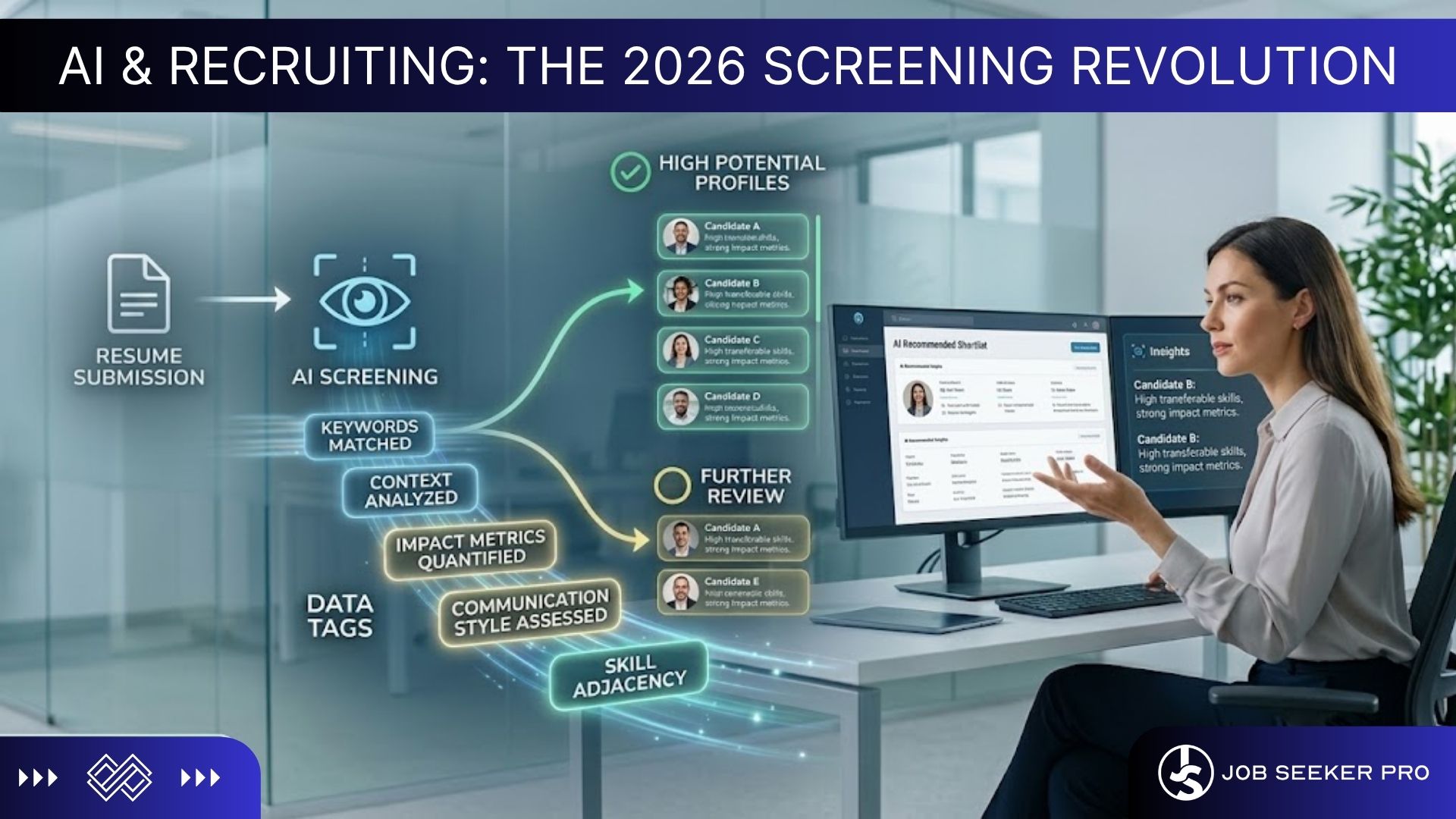
For years, job seekers believed beating Applicant Tracking Systems (ATS) was all about stuffing resumes with keywords.
That’s no longer true.
In 2026, AI-powered recruiting tools have evolved far beyond simple keyword matching. Modern hiring systems now evaluate context, consistency, communication patterns, measurable impact, and even inferred skills. Recruiters are no longer just searching for resumes that “contain the right words.” They’re looking for evidence of capability.
And that changes everything.
According to multiple 2026 hiring reports, most companies now use AI in at least one stage of hiring, with recruiters increasingly relying on automation to manage application volume and reduce screening time.
So, what are these systems actually looking for now?
Let's dive into the 7 key elements.
🔹1. Context, Not Just Keywords
Older ATS systems worked like search engines.
If a job description mentioned “project management,” the system looked for those exact words in your resume. Candidates quickly learned to mirror job descriptions to pass the filter.
Today’s AI systems use semantic matching.
That means the software understands related concepts and evaluates how skills are applied in real situations. Instead of simply detecting “leadership,” AI now analyzes whether your experience demonstrates leadership behaviors through outcomes, scope, and responsibility.
For example:
- “Managed cross-functional teams across 3 departments”
- “Led migration project completed 2 weeks early”
- “Coordinated stakeholder communication during acquisition”
These statements carry more weight than a standalone “Leadership Skills” section.
Modern screening tools increasingly score resumes based on demonstrated competency rather than isolated terminology.
🔹2. Evidence of Impact
Recruiters are overwhelmed by application volume in 2026.
AI is helping them prioritize candidates who show measurable business impact.
That means systems now favor resumes with:
- Metrics
- Outcomes
- Specific achievements
- Quantifiable improvements
Compare these two examples:
❌ “Responsible for social media campaigns.”
✅ “Increased LinkedIn engagement by 47% in 6 months through targeted B2B campaigns.”
The second example gives the AI more usable signal:
- Action
- Ownership
- Metric
- Business result
Many recruiting systems now rank candidates higher when accomplishments are framed with data because measurable outcomes are easier to compare across applicants.
🔹3. Skill Adjacency and Transferable Skills
One major shift in 2026 hiring is the rise of skills-based recruiting.
AI systems are increasingly trained to identify adjacent or transferable capabilities rather than requiring perfect background matches.
For example:
- Customer success → account management
- Journalism → content strategy
- Teaching → corporate training
- Operations → project coordination
This is especially important as employers move away from rigid degree requirements and toward capability-based hiring models.
Candidates who explain how their experience transfers across industries are performing better than candidates who simply list responsibilities.
🔹4. Communication Quality
This surprises many job seekers.
AI screening tools are increasingly evaluating writing clarity, structure, and communication style.
Not in a “grading your grammar” way.
But in a signal-detection way.
Systems now analyze:
- Clarity
- Readability
- Conciseness
- Consistency
- Professional tone
- Resume organization
Why?
Because communication quality correlates strongly with workplace effectiveness across many roles.
Ironically, recruiters also report they can increasingly spot resumes that feel overly AI-generated or generic. One 2026 hiring survey found that 80% of hiring managers say they can identify AI-written resumes “at a glance.”
That means candidates face a new balancing act:
Use AI to improve your resume, but don’t let it erase your voice.
🔹5. Consistency Across Your Career Narrative
Modern AI recruiting systems now cross-reference information more intelligently.
They evaluate:
- Career progression
- Timeline consistency
- Skill evolution
- Role alignment
- Employment patterns
Large gaps aren’t always disqualifying anymore.
But unexplained inconsistencies create friction.
For example:
- Senior titles with junior-level accomplishments
- Skills listed without supporting experience
- Repeated buzzwords with no measurable evidence
- Contradictory LinkedIn and resume information
AI systems are increasingly trained to detect credibility signals, not just qualifications.
🔹6. Behavioral and Cognitive Signals
Some companies now use AI-assisted assessments before human interviews even begin.
These include:
- Communication analysis
- Problem-solving simulations
- Cognitive skill testing
- Video interview analysis
- Situational judgment assessments
Research published in 2025 and 2026 shows that companies are experimenting with structured AI-assisted screening workflows to predict candidate success more efficiently.
This doesn’t mean AI is making final hiring decisions independently.
In most organizations, recruiters still make the final call.
But AI increasingly influences which candidates get seen first.
And that’s the real power shift.
🔹7. Authenticity Signals
Perhaps the biggest change in 2026 recruiting is this:
Recruiters are actively looking for signs that a candidate is real.
Why?
Because AI-generated applications have exploded.
Hiring teams now deal with:
- Mass-produced resumes
- Auto-generated cover letters
- AI-assisted interview answers
- Fake applicants
- Deepfake interview concerns
As a result, recruiters are placing more emphasis on authenticity, specificity, and human credibility.
The strongest resumes in 2026 don’t sound “perfect.”
They sound specific.
They include:
- Real accomplishments
- Clear career stories
- Unique insights
- Concrete examples
- Human voice
That’s what modern AI systems .... and recruiters .... increasingly reward.
🔹Final Thought
The hiring process in 2026 is no longer a battle between humans and machines.
It’s a signal-quality problem.
Recruiters use AI to identify patterns, prioritize relevance, and manage overwhelming application volume. But the candidates who stand out are still the ones who communicate real value clearly and credibly.
The old strategy was:
“Match the keywords.”
The new strategy is:
“Demonstrate capability.”
That’s a very different game.
The average online job receives >250 applications, what is your PLAN to stand out? This training is your plan:
