You Have More Career Options Than You Think
Oct 30, 2026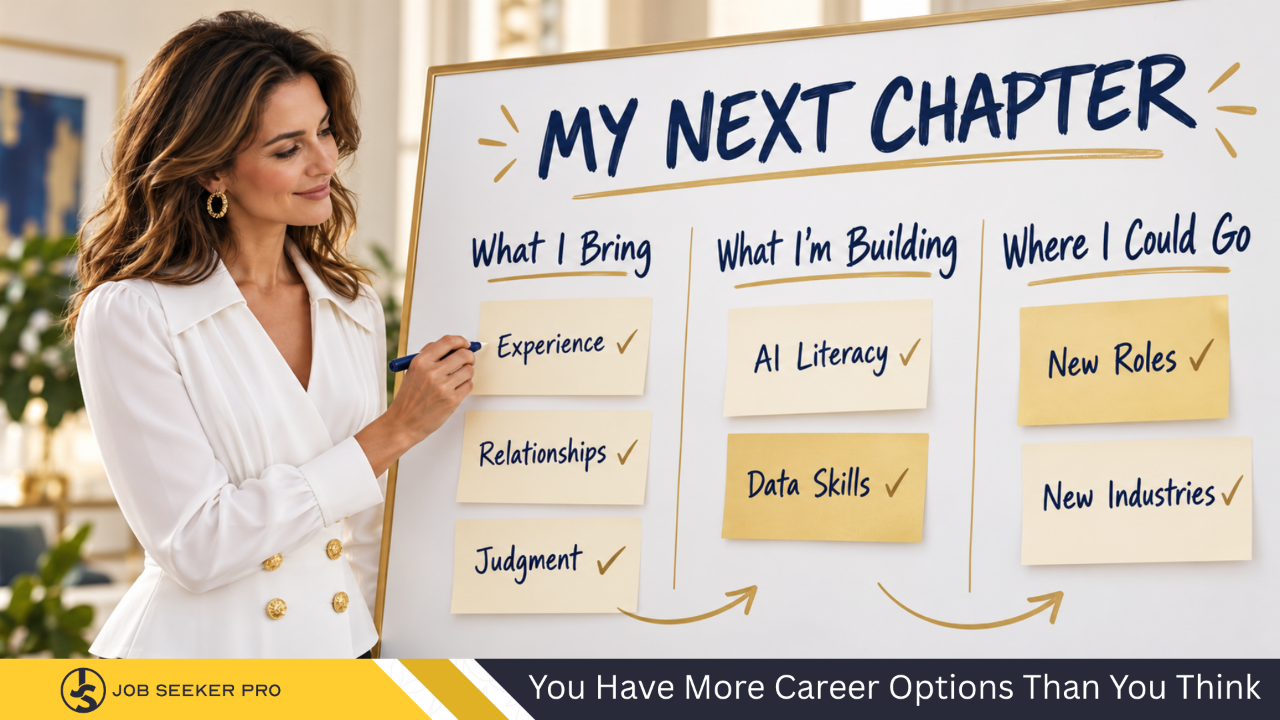
You cannot control every change in the job market. But you can build more options for what comes next.
A job search can make an accomplished professional question everything.
You spend years solving problems, supporting customers, leading projects, and helping a business succeed. Then you find yourself staring at a job posting, wondering whether you are qualified to do work you could probably teach.
You revise your résumé. Submit another application. Refresh your inbox.
Somewhere along the way, the question changes from “Where do I want to work?” to “Does anyone still need what I know?”
That is a difficult place to be.
It is also a moment to look more closely at what you bring.
Your last employer gave you a job title. Your experience gave you capabilities you can take with you.
The next step is recognizing those capabilities, strengthening them, and helping another employer see where they fit.
That is the idea behind “career insurance.”
Give yourself more ways forward
No skill can guarantee that you will avoid a layoff. Excellent performers lose jobs. Businesses close. Budgets shrink. Hiring decisions can turn on circumstances you never see.
Career insurance means building skills that give you options when those circumstances change.
Consider how easily we attach our professional identity to a particular setting.
- “I have spent fifteen years in retail.”
- “I have only worked in manufacturing.”
- “My experience is all in one company.”
The word only can hide a great deal.
During those years, did you negotiate agreements? Develop employees? Improve a process? Interpret customer behavior? Manage competing deadlines? Help people adopt a change they initially resisted?
Those capabilities deserve a place in your career story.
They do not automatically qualify you for every industry. They do give you something concrete to investigate beyond the boundaries of your last job title.
Before you assume you must start over, examine what you have already built.
Learn the tools that are changing the work
AI is an example of why that examination needs to include new learning.
LinkedIn’s October 27, 2026 update reports that the share of job postings requiring AI literacy increased roughly 65% over the previous 12 months. Demand extends beyond technology roles into marketing, design, project management, administration, and writing.
For someone already navigating a job search, that can sound like one more requirement added to an exhausting list.
You do not have to master every platform released before breakfast.
Start with a task you understand.
Use an AI tool to help organize a project outline, summarize public information, or develop questions for a customer discussion. Evaluate what it produces. Find the gaps. Revise the instructions. Notice where your experience improves the result.
That last part matters.
If you have ever watched AI produce a beautifully formatted answer containing a completely imaginary fact, you understand the value of informed oversight.
Your goal is to become capable of explaining how you use the tool, where it helps, and how you check its work.
New technology gives you something to learn. Your existing expertise gives you a way to judge it.
Make your experience useful to someone new
Communication, collaboration, and leadership also feature prominently in LinkedIn’s 2026 Skills on the Rise report.
Yet professionals often reduce these capabilities to résumé phrases that reveal almost nothing.
- “Excellent communicator.”
- “Strong relationship builder.”
- “Results-oriented professional.”
These descriptions are so familiar that a reader can glide past them without learning a thing about you.
Give them a situation they can understand.
Perhaps two departments disagreed about priorities, and you helped them reach a workable decision. Perhaps a customer was ready to leave, and you uncovered a problem nobody had addressed. Perhaps leadership needed a recommendation, and you translated complicated information into a clear choice.
Explain what happened. Identify your contribution. Show the result.
The same applies to project execution. “Managed projects” leaves the reader guessing. Bringing a delayed launch back on schedule while coordinating vendors, resolving dependencies, and keeping customers informed gives them something to discuss.
You have probably done work that felt ordinary because people depended on you to do it regularly.
Look at it again through the eyes of someone who needs that problem solved.
Strengthen your judgment
The World Economic Forum’s Future of Jobs Report 2025 identifies analytical thinking as the leading core skill among surveyed employers.
That has practical meaning far beyond spreadsheets.
Can you recognize when a number lacks context? Question an assumption before a team builds a plan around it? Distinguish a symptom from the problem causing it?
A report might show more customer inquiries. Your judgment helps determine whether those inquiries represent growth, confusion, or a service issue.
A project might be behind schedule. Your investigation helps reveal whether the team needs more resources, clearer decisions, or fewer competing priorities.
These are capabilities you can develop through practice. They also give experienced professionals a useful way to connect years of work with current business needs.
Think about a time you noticed something others missed.
What did you question? What did you discover? What changed because you spoke up?
There may be a stronger interview story there than the one you have been rehearsing.
Let learning include a little discomfort
Building career options requires being willing to feel inexperienced again.
That can be surprisingly difficult when you have spent years being the person others ask for help.
A new tool feels awkward. A practice interview exposes an unclear answer. A small project reveals that your first solution does not work.
None of those experiences cancels your previous accomplishments. Each gives you information you can use.
Adaptability becomes visible when you act on that information: revise the approach, ask a better question, seek feedback, and try again.
You do not need to present yourself as someone who has never struggled.
You need examples of how you respond when the work demands something new.
Build something you can point to
Skills become more convincing when another person can see evidence of them.
In a September 2026 survey of 3,128 U.S. hiring professionals, Western Governors University found that 60% said AI makes candidates’ actual skills harder to evaluate.
Help an employer understand what you can do.
Prepare a clear accomplishment story. Create a relevant sample using fictional information. Complete a small project. Explain a decision you made and the evidence behind it.
A course can help you learn. Applying that learning gives you something more specific to discuss.
Choose one capability that appears repeatedly in roles you want. Then give yourself a manageable assignment that strengthens it and produces evidence.
One useful step is enough to begin.
Your next chapter needs your participation
You cannot make an employer respond. You cannot personally reverse a hiring slowdown. And you do not need to turn every rejection into a cheerful lesson by lunchtime.
You can give yourself credit for what you have learned while staying willing to learn more.
You can stop describing fourteen years of problem-solving as “just experience in one company.”
You can make your communication clearer, your judgment stronger, your technology skills more current, and your accomplishments easier to understand.
That is work with a purpose: expanding the opportunities you are prepared to pursue.
Your career is still being built. Start with what you know, strengthen what comes next, and give yourself more places to go.
Let's explore what comes next
It can be hard to recognize your own strengths when you’ve spent years simply thinking of them as “doing your job.”
If you’re wondering how your experience could translate into a different role or industry, we’re here to help. At Job Seeker Pro, we can help you talk through your strengths, explore possible directions, and communicate what you bring to your next opportunity.
Reach out to start a conversation. Your next chapter may have more possibilities than you realize.
Brian Howard - Job Seeker Pro
The average online job receives >250 applications, what is your PLAN to stand out? This training is your plan:
