Build Interview Confidence by Practicing Out Loud
Aug 25, 2026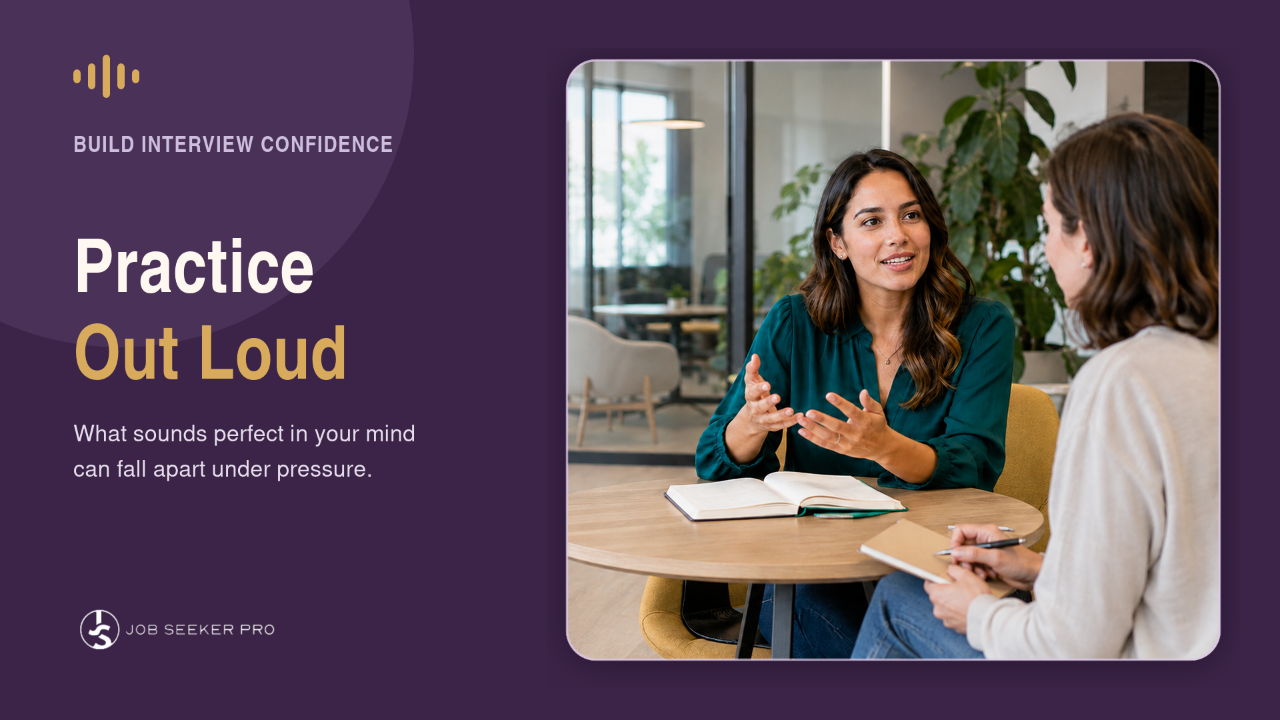
An answer that sounds perfect in your mind can fall apart under pressure.
You can know exactly what you want to say and still struggle to say it when someone is waiting for your answer.
You researched the company. You studied the job description. You reviewed the questions you might be asked. You even thought through several examples from your career.
Then the interviewer says:
“Tell me about a difficult problem you solved.”
You know the answer.
But once you begin speaking, the story starts to unravel.
You provide too much background. You repeat yourself. You forget an important detail. Your strongest accomplishment gets buried beneath several minutes of explanation.
When you finally stop talking, you wonder whether you answered the question at all.
This happens to intelligent, highly qualified professionals every day.
The problem is not that they lack experience.
They practiced thinking about their answers, but they never practiced saying them out loud.
Silent Preparation Can Create False Confidence
Answers often sound better inside our minds.
You already understand the project, the people involved, the terminology, and the decisions that were made. Your brain automatically fills in any missing information.
The interviewer cannot do that.
The interviewer only hears the words you choose, the order in which you present them, and the confidence with which you deliver them.
Thinking through an answer helps you identify what you want to discuss.
Practicing out loud reveals whether another person can actually understand it.
You may discover that:
- Your two-minute answer takes five minutes.
- You spend too much time explaining the situation.
- Your personal contribution is unclear.
- You describe responsibilities instead of accomplishments.
- You use terminology the interviewer may not understand.
- You forget to explain the result.
- Your strongest evidence appears at the very end.
You cannot hear these weaknesses while the answer remains inside your head.
A Strong Accomplishment Can Still Become a Weak Answer
Consider a project manager preparing for an important interview.
She had helped rescue a $400,000 client initiative that was three weeks behind schedule. She reorganized the project plan, resolved a resource conflict between two departments, and helped the team meet the original launch date.
It should have been one of the strongest stories in her interview.
During her first practice attempt, she spent several minutes describing the company, the project history, the departments involved, and every problem the team had encountered.
Her practice partner listened carefully and then asked:
“What did you personally do?”
That question exposed the problem.
Her experience was impressive, but her contribution had disappeared inside the explanation.
She practiced the answer again. This time, she reduced the background, clarified her actions, and ended with the result.
The accomplishment did not change.
The way she communicated its value changed.
Compare These Two Answers
Here is the vague version:
“We were having several problems with a project, and the departments involved could not agree on priorities. I attended a lot of meetings and worked with everyone to get things organized so we could finish on time.”
The answer is not necessarily wrong, but it leaves important questions unanswered.
What did the candidate personally do?
What decisions did she make?
What changed because of her involvement?
Now consider the stronger version:
“A $400,000 client initiative had fallen three weeks behind schedule because two departments had conflicting priorities. I brought both department leaders together, clarified the critical dependencies, and created a recovery plan with new deadlines and clear owners. We recovered the lost time and completed the launch on schedule.”
The second answer gives the interviewer something specific to remember.
The challenge is clear. The candidate’s actions are visible. The result demonstrates value.
The candidate did not gain more experience between the two answers.
She learned to communicate the experience more effectively.
Practice in Three Stages
Strong interview preparation should become progressively more realistic.
Stage 1: Answer the Question Alone
Choose several questions you are likely to hear:
- Tell me about yourself.
- Why are you interested in this position?
- Tell me about a difficult problem you solved.
- Describe a time you handled conflict.
- What professional accomplishment are you most proud of?
Select one question and answer it out loud without using notes.
Do not worry about sounding perfect. Your first goal is simply to hear how the answer comes together.
Pay attention to where you hesitate, repeat yourself, or lose the direction of the story.
Stage 2: Record Yourself
Use your phone or computer to record the answer.
Do not stop and restart when you make a mistake. You need to hear how you currently communicate under imperfect conditions.
Listen to the entire recording and ask:
- Did I answer the question directly?
- Was my personal role clear?
- Did I provide a specific example?
- Did I spend too much time explaining the background?
- Did I explain why the result mattered?
- Did I sound natural and confident?
- What is the one point an interviewer would remember?
Revise the answer and record it again.
Most people will hear a noticeable improvement by the second or third attempt.
Not because their experience changed, but because they learned to communicate it more clearly.
Stage 3: Practice With Another Person
Practice alone first. Then ask someone you trust to listen, challenge your answers, and ask follow-up questions.
Your practice partner does not need to be a professional recruiter. A friend, colleague, mentor, career coach, or trusted professional can help.
Give the person the job description and several questions you expect to hear.
Ask them to respond as an interviewer would:
- Request clarification when something is confusing.
- Ask what you personally contributed.
- Question why you chose a particular approach.
- Ask what happened next.
- Request a measurable result.
- Change the order of the questions.
- Interrupt with an unexpected follow-up.
This is where interview practice becomes especially valuable.
A recorded answer helps you hear yourself.
A practice partner helps you understand how another person hears you.
Use the CLEAR Test
Before considering an interview story ready, put it through the CLEAR Test.
C: Is the context brief?
Give the interviewer enough information to understand the situation, but do not provide the entire history of the company or project.
L: Is the language easy to understand?
Remove unnecessary jargon, acronyms, and technical explanations. Your answer should make sense even if the interviewer does not share your professional background.
E: Is the evidence specific?
Include facts that make the accomplishment credible. Use numbers, deadlines, percentages, cost savings, customer outcomes, or other measurable results when available.
A: Are your actions unmistakable?
Explain what you personally analyzed, created, recommended, improved, resolved, or delivered. Do not allow the word “we” to hide your contribution.
R: Is the result memorable?
End by explaining what changed. Did you save time, reduce costs, improve quality, prevent a delay, strengthen a relationship, increase revenue, or solve an important problem?
The interviewer should not have to search through your answer to understand your value.
Make it easy to recognize.
Aim for Clarity, Not a Perfect Script
The goal of practicing out loud is not to memorize every word.
Memorized answers can sound stiff. They may also become difficult to deliver if the interviewer phrases the question differently or asks an unexpected follow-up.
Instead, become familiar with the essential parts of each story:
- What was the challenge?
- What did you personally do?
- Why did you choose that approach?
- What was the result?
- What does the story demonstrate about you?
Your wording can change from one practice attempt to another.
The value of the story should remain clear.
For many behavioral questions, approximately 60 to 120 seconds is enough time to provide a meaningful answer without overwhelming the interviewer.
This is not a rigid rule. Some questions require more explanation than others.
The goal is clarity, not speed.
Practice the Conditions, Not Just the Words
If your interview will be virtual, practice using the same computer, camera, microphone, and location you plan to use.
Check your lighting, sound, posture, eye contact, and background.
If the interview will be in person, practice while sitting across from someone. Notice whether you maintain eye contact, rush your words, speak too quietly, or become distracted by the other person’s reactions.
The closer your practice feels to the real interview, the more familiar the actual experience will become.
You may still feel nervous, but you will not be searching for your examples and organizing your thoughts for the first time.
You will have already practiced communicating them.
Confidence Comes From Familiarity
A brief pause will not ruin your answer.
Correcting a word will not ruin your answer.
Taking a moment to think will not ruin your answer.
Interviewers are not searching for flawless performers. They are trying to understand how you think, communicate, solve problems, and produce results.
You do not need to sound perfect.
You need to make your value clear.
Give Your Experience a Stronger Voice
You may have spent years building your knowledge, solving difficult problems, supporting important clients, leading complicated projects, or helping an organization through challenging moments.
Those experiences deserve more than a rushed explanation created during the interview.
Before your next interview:
- Choose three questions.
- Answer each one out loud.
- Record and review your responses.
- Improve the parts that are unclear.
- Practice again with someone you trust.
Remove what is unnecessary. Strengthen what matters. Make your contribution unmistakable.
Your experience is already valuable. Practicing out loud helps the interviewer hear that value with greater clarity and confidence.
Brian Howard - Job Seeker Pro
The average online job receives >250 applications, what is your PLAN to stand out? This training is your plan:
